Teachers College Reading and Writing Sports Debate
Young people more often than not are often portrayed as beingness full of ambitions and hopes for the globe and, therefore, important drivers of cultural change. The Un Population Fund describes well this expectation on young people as shapers of the culture of the future:
Every bit they grow through adolescence, young people develop their identity and become autonomous individuals. Young people exercise not share their elders' experiences and memories. They develop their ain ways of perceiving, affectionate, classifying and distinguishing issues, and the codes, symbols and language in which to express them. Young people's responses to the changing world, and their unique ways of explaining and communicating their experience, can assistance transform their cultures and prepare their societies to encounter new challenges. … Their dynamism can change some of the primitive and harmful aspects of their cultures that older generations take to exist immutable.1
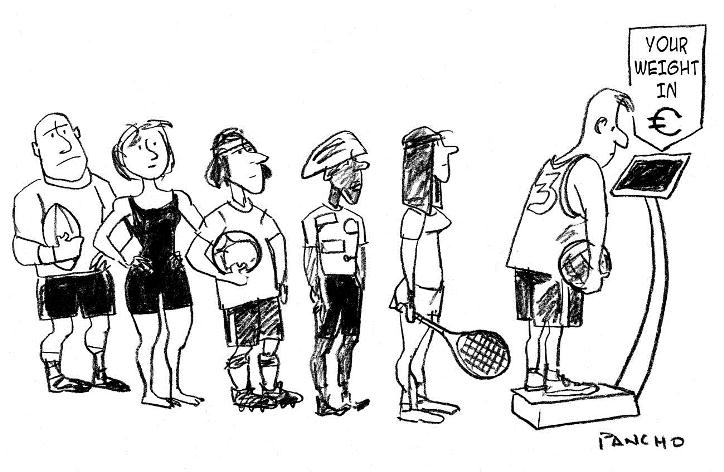
Sport is a universal element in all cultures and therefore we accept called to include it as a theme for Compass. Sport is popular particularly with immature people; statistics show that 61% of immature people aged between xv and 24 participate regularly (at least once a week) in sporting activities in the EU2ii. Another reason for including sport is that sports provide young people with opportunities for social interaction through which they can develop the knowledge, skills and attitudes necessary for their full participation in civil gild.
Civilisation and sport are both human rights and related to various other human rights. They are as well the grounds on which human rights are often challenged and abused, including those of young people.
What do nosotros hateful by "culture"?
The word "civilisation" is used in many different ways, for case, popular civilisation, mass civilization, urban culture, feminist civilization, minority culture, corporate culture and, last merely non least, youth culture. We tin can also talk about a cultured person, meaning someone who has skillful manners and is formally educated in the traditions of literature and art, or about civilization shock: a person's disorientation and frustration when experiencing an unfamiliar civilisation. None of these meanings of "civilisation" is usually dealt with by ministries of civilization or their equivalent governmental regime.
The discussion "culture" comes from the Latin, "cultura" pregnant "to tend, guard, cultivate, till". Information technology was first effectually 1500 CE that the word started to appear in the figurative sense of "tillage through education" and it was only in the mid-19th century that the word was linked to ideas about the collective customs and ways of life of different societies.4 It is this meaning of culture every bit inherited patterns of shared meanings and mutual understandings that nosotros address in this department.
No civilisation is homogenous. Within each culture, information technology is possible to place "subcultures": groups of people with distinctive sets of practices and behaviours that set them autonomously from the larger culture and from other subcultures. Culture is equally difficult to define every bit it is to seize; cultures are e'er evolving and irresolute. To paraphrase Heraclitus about not stepping twice in the aforementioned river, the culture in which we communicate today is not the same in which we communicated yesterday. Still, in our eyes and perceptions, information technology is truly the aforementioned.
Question: What new ideas or technologies have changed your culture in the last ten years?
The Un Committee on Economical, Social and Cultural Rights defines culture as follows:
Culture […] encompasses, inter alia, ways of life, language, oral and written literature, music and song, non-verbal advice, faith or belief systems, rites and ceremonies, sport and games, methods of production or technology, natural and man-made environments, nutrient, clothing and shelter and the arts, customs and traditions through which individuals, groups of individuals and communities limited their humanity and the meaning they give to their existence, and build their world view representing their run into with the external forces affecting their lives.v
Some aspects of culture are highly visible, for example the mode people dress. Other aspects are mostly unconscious, well-nigh instinctive. One fashion of thinking about culture is to use the metaphor of an iceberg. An iceberg has a visible part above the waterline and a larger, invisible section below. In the aforementioned style, culture has some aspects that can be observed and of which we are witting and other aspects that can only be suspected or imagined and reached through dialogue and introspection. Merely as the root of the iceberg is much larger than the upper function, so is the greater part of culture "invisible". The take a chance is to take the office for the whole. By focusing on what is visible to u.s. (and that nosotros seem to "empathise") we risk missing the essential in the persons, in the man beings.
Question: What aspects of your civilisation are, in your understanding, invisible to others?
Culture is also the lens through which we view and interpret life and society. Culture is passed over from one generation to the next i, while incorporating new elements and discarding others. Because we accept taken so much of the prevailing civilisation in with our mother's milk it is very hard to view our own civilization objectively; it just seems to be normal and natural that our own civilization feels "right" and other cultures with their different ways of thinking and doing seem unusual – perhaps even incorrect.
Culture is too explained as a dynamic construct made by people themselves in response to their needs. Consider for a moment the arctic environment of northern Sweden; people in that location face up different challenges from people living on the warm shores of the Mediterranean; consequently they have developed different responses – different means of life – cultures.
Today, as a outcome of modern applied science and globalisation, the two cultures accept more in common than they did in the past, but nonetheless they still have many differences, including different notions of what information technology means to exist European.
Who nosotros are or believe we are depends to a large extent on the cultures we grow upwardly in, are exposed to or decided to cover. Each of the states, still, is also unique. Information technology is the accident of where nosotros are born that initially defines, for instance, the languages we commencement learn to speak, the nutrient we like all-time and the religion we follow, or non. Identity, like culture, is a circuitous concept with parts above and beneath the line of consciousness that alter with time and location. We can talk about personal identity, gender identity, national, cultural, ethnical, class or familial identity, and in fact nigh any other sort of identity. Accepting that identity is intricate, diverse and dynamic and about being oneself, and at the same fourth dimension recognising and accepting others' rights to express their ain identities is essential to building a civilization of human rights, where everyone is due equal rights and respect. Identity is what makes each of the states unique. However, this uniqueness is non the same throughout our lives; information technology is e'er changing.
What practise we mean past "sport"?
Sports, and especially team games, are an important part of our lives, whether nosotros are spectators or participants. For many, football game is a never-ending source of conversation, fans feel a deep affinity with their team, and star players are given the status of heroes. The electric current fashion for people to want to await good, youthful, athletic and good for you is manifested by the number of fitness clubs opening up and the quantity of magazines published about slimming, while parks are filled with joggers. Other activities which involve mental rather than physical exertion, such equally chess, are also considered sports. There are sports to accommodate all tastes and temperaments and thus sport can truly be closely linked to our identity and culture at some point in our life.
If we look deeper into the underlying value and purpose of sports and games – and this includes the play of young children – it becomes credible that all sports, whether football game, spear throwing or yoga, have developed as a means of teaching necessary life skills, which is why sports are seen equally an important part of the educational curriculum, both formal and non-formal.
Cultural rights
Cultural rights were first enshrined in the Universal Declaration of Human Rights, Article 27:
Everyone has the right freely to participate in the cultural life of the customs, to enjoy the arts and to share in scientific advancement and its benefits.
Protecting and promoting cultural rights is of import to the process of empowering individuals and communities. Having their cultural rights recognised helps communities to build their self-esteem and to be motivated to maintain their traditions while existence respected for their practices and values.
According to the Human Rights Education Assembly, the right to culture in human rights law is substantially most the celebration and protection of humankind's creativity and traditions. The right of an individual to enjoy culture and to advance culture and scientific discipline without interference from the land is a human being right. Under international human rights law governments as well accept an obligation to promote and conserve cultural activities and artefacts, particularly those of universal value. Culture is overwhelmingly applauded equally positive in the vast majority of man rights instruments. The right to civilisation includes a variety of components:
• the right to take part in cultural life
• the right to enjoy the benefits of scientific progress
• the correct of the individual to benefit from the protection of the moral and material interests resulting from any scientific, literary or creative production of which he is the author.
• the correct to freedom from the interference of the land in scientific or creative pursuits.9
Several other aspects of civilization are likewise protected in international human rights, for instance the correct to marry and found a family, the right to express an opinion freely, the correct to education, to receive and impart information, the right to balance and leisure, and the correct to freedom of thought, conscience and religion.
Question: What other human rights are related to culture?
In relation to children, the CRC stipulates that the pedagogy of the child shall be directed to "... the development of the child's personality, talents and mental and concrete abilities to their fullest potential", and Article 31 refers to the right to remainder and leisure, to appoint in play and recreational activities advisable to the historic period of the child. Sports and games are essential activities for the personal and social development, growth and well-existence of children and young people.
In 1966, the International Covenant on Economic, Social and Cultural Rights (ICESCR) emphasised the importance of culture: "recognising that, in accordance with the Universal Announcement of Homo Rights, the platonic of costless human beings enjoying liberty from fright and desire tin merely be achieved if conditions are created whereby everyone may enjoy his economic, social and cultural rights, as well equally his civil and political rights".
The UNESCO Principles on International Cultural Co-operation (1966) also state that the wide diffusion of culture and the education of humanity, liberty and peace are indispensable to the nobility of man. Commodity I states:
one. Each culture has a nobility and value, which must be respected and preserved.
2. Every people take the correct and the duty to develop its culture.
3. In their rich multifariousness and multifariousness, and in the reciprocal influences they exert on 1 another, all cultures form part of the common heritage belonging to all mankind.xi
In 2007, the adoption of the Proclamation of the Rights of Indigenous People12 was an impor-
tant step in clarifying the concept of culture within human rights police. Information technology affirms that indigenous
peoples are equal to all other peoples, while recognising the right of all peoples to exist unlike, to consider themselves different, and to be respected as such, and affirms too that all peoples contribute to the variety and richness of civilisations and cultures, which constitute the mutual heritage of humankind.
Declaration of the Rights of Ethnic People
Commodity 8
1. Indigenous peoples and individuals have the right not to be subjected to forced assimilation or destruction of their culture.
2. States shall provide effective mechanisms for prevention of, and redress for:
(a) Whatever action, which has the aim or effect of depriving them of their integrity as singled-out peoples, or of their cultural values or ethnic identities;
Article 11
1. Indigenous peoples take the correct to practise and revitalize their cultural traditions and customs. This includes the correct to maintain, protect and develop the by, present and future manifestations of their cultures, such as archaeological and historical sites, artefacts, designs, ceremonies, technologies and visual and performing arts and literature.
Can cultural practices violate human rights?
The UNESCO Principles on International Cultural Co-functioning states that each civilization has a dignity and value, which must exist respected and preserved. What does this principle hateful in do?
Practices such as balderdash fights, showing fanatical support for a football game guild, drinking warm beer, hunting whales or eating horse meat may be important practices to some but seem daft or even offensive to others. At that place are other practices that accept more fundamental consequences for people'south rights and dignity, for instance, the use of capital punishment, customs about being sexually active (or not) before marriage, wearing religious symbols, or corporal penalty of children.
Question: Should all cultural practices be respected?
The United Nations takes a articulate stand on this issue: one right cannot exist used to violate other rights, as stated the Universal Annunciation of Human Rights:
[…] cultural rights cannot be invoked or interpreted in such a mode as to justify any act leading to the denial or violation of other homo rights and fundamental freedoms. As such, claiming cultural relativism as an excuse to violate or deny human rights is an corruption of the correct to culture.
There are legitimate, noun limitations on cultural practices, fifty-fifty on well-entrenched traditions. For example, no culture today can legitimately merits a right to practise slavery.
Despite its practice in many cultures throughout history, slavery today cannot be considered legitimate, legal, or part of a cultural legacy entitled to protection in whatsoever style. To the contrary, all forms of slavery, including contemporary slavery-like practices, are a gross violation of human rights under international police.
Similarly, cultural rights do not justify torture, murder, genocide, discrimination on grounds of sex, race, language or faith, or violation of any of the other universal homo rights and key freedoms established in international law. Whatsoever attempts to justify such violations on the basis of culture have no validity under international police force.xiii
Among the pitfalls of making unconsidered claims about cultural rights is that we may autumn into the trap of labelling people, "putting them in a box" co-ordinate to their civilisation, and consequently perpetuating stereotypes and prejudices. It is especially typical of representatives of a majority culture to consider all choices, actions or decisions of the fellow member of a minority group as something related to their culture, while they consider their ain deportment, choices or decisions every bit non at all influenced past culture, but equally beingness "objective".
Cultural multifariousness is a natural consequence of the combination of human dignity and human rights in their entirety. Man rights guarantee the liberty of thought, religion, conventionalities, cultural expression, education, and and so on. In the same mode that the ability of majorities cannot exist used to suppress the man rights of minorities, the cultural rights of minorities cannot exist used to justify violations of man rights, exist they perpetrated past minorities themselves or by the majorities.
Respect for diversity ought to occur in a human rights framework and non be used as a reason for discrimination. Multifariousness is only possible in nobility; equality has to coexist with diverseness.
Sports and human being rights
Pierre de Coubertin – "father" of the modern Olympic Games – believed that sports events in general and international ones in item were important tools for the promotion of human rights:
sports should accept the explicit function to encourage agile peace, international understanding in a spirit of common respect betwixt people from different origins, ideologies and creeds.
No human rights declarations or covenants contain a specific mention of sport. Nonetheless, the International Olympic Commission (IOC) stated in its Olympic Lease that the "exercise of sport is a human right. Every individual must have the possibility of practising sport, without discrimination of any kind and in the Olympic spirit".15
Participation in sport can promote human rights through generating shared interests and values and teaching social skills that are necessary for democratic citizenship. Sport enhances social and cultural life by bringing together individuals and communities. Sports can help to overcome difference and encourages dialogue, and thereby helps to pause down prejudice, stereotypes, cultural differences, ignorance, intolerance and bigotry.
Sport is often used as a first step to engage vulnerable and marginalised groups. Street football is used in many inner city areas as a mode for youth workers to make contact with alienated young people. The Homeless World Cup is an international football tournament where teams are made upward entirely of homeless people. The event has been held annually since 2003. On the official website of the organisation we tin can read that "… the enquiry into the touch on of the Copenhagen 2007 Homeless Globe Cup one time again demonstrates significant change in the lives of the players - 71% of players came off drugs and alcohol, moving into jobs, homes,
training, teaching, repairing relationships all whilst continuing to play football".sixteen
Sports players equally role models
Sportsmen and sportswomen are often admired for their status, achievements, and sometimes for their inspiring journeying to success. Many young people look upward to them for their efforts to fight for social justice and human rights. For example, Lilian Thuram is the most capped role player in the history of the French National football team and known for his fight against racism and defence of young people. Eric Cantona is besides a famous former footballer. He came from a poor immigrant family and is at present well known for interim, and his back up for the homeless.
The UN relies on some prominent personalities from the world of art, music, film, literature and sport to draw attention to its activities and promote the mission of the organisation.
Examples include the following: footballer Leo Messi, Goodwill Ambassador for UNICEF; tennis star Maria Sharapova, Goodwill Administrator for the UN Development Program (UNDP) and vocaliser Céline Dion, UNESCO Artist for Peace.17
Sport Without Borders18
Sport Without Borders is a non-profit system started by a grouping of athletes from a variety of sports. It is committed to defending the correct to play and to participate in sports: every child, irrespective of socio-economic status or the context in which (south)he lives, must accept the right to play and to participate in sport; information technology promotes educational activity through sport working with at-take a chance populations and is thus contributing to the fight against inequality. Its motto is "Solidarity is primarily a commonage sport".
www.playthegame.org
Human rights violations related to sports
The utilise of performance enhancing drugs is probably the most well known abuse of homo dignity and health. There are likewise controversial issues of hormone treatment and sex-testing of women athletes that have to do with respect, human nobility and the right to privacy. Sponsors can exploit sportsmen and women, and aggressive parents tin can exploit children who demonstrate precocious power. Intensive grooming and pressure to compete can lead to sports injuries and be a risk to mental well-being.
Sporting opportunities are non always inclusive and in that location are oftentimes elements of discrimination against women, religious or cultural minorities or other groups in access to sports facilities, for instance, football classes offered merely for boys at schoolhouse. Commercial pressures and interests may lead to human rights abuses that undermine dignity and respect for others. For instance, some players accept bribes to commit "professional fouls" in soccer or to fix matches in cricket.
Some human being rights abuses are associated with the globalisation of the sporting goods industry. For instance, sportswear and equipment suppliers have been criticised for contracting with factories where kid labour is used.
Question: Are all sports equally accessible to all young people?
The most common human rights claiming related to sport is equality and non-discrimination.
The effective exercise of equality in access to sport is faced with various economic, social and logistical barriers: beingness of sport facilities, being able to admission them and to afford them, beingness admitted to sports clubs and facilities, accessibility of the facilities, and then on. Despite the widely recognised integration role of sport, in well-nigh countries many young people are de facto deprived from access to sport.
Sport and politics
Sport has long been used as a peaceful means of political action confronting injustice. During the apartheid era, many countries refused to accept sporting relations with South Africa, which made a meaning contribution to political change in that country. In 1992, the Federal Republic of Yugoslavia was replaced by Denmark in the UEFA European Football Championship because of the state of war amongst republics in old Yugoslavia.
However, sport may also be misused for nationalistic or political purposes. For instance, at the 1972 Munich Olympic Games, 8 Palestinian terrorists invaded the Israeli team headquarters to have hostages. Two of the sportsmen were killed in the brawl, and nine hostages were murdered after a failed rescue attempt past German law. The Olympic Games, in particular, have long been used as a forum for nations to make political statements. For example, the U.s. of America together with 65 other nations boycotted the Moscow games of 1980 because of the Soviet invasion of Transitional islamic state of afghanistan. The Soviet Union and fifteen of its allies and so boycotted the next games in Los Angeles in 1984 for security reasons and fears of political asylum being sought and given. More recently the pick of Beijing for the 2008 Olympic Games was criticised because of Red china'due south lack of republic and human rights abuses.
Sport and racism
Racism in sport can impact all sports and tin manifest itself at several levels, in apprentice sport and at institutional and international levels, too every bit in the media. It can occur at local level specially, only non exclusively, in the interaction (for real or imagined reasons of color, religion, nationality or ethnic origin) between or confronting players, teams, coaches and spectators and also against referees.
The responsibility for combating racism in sport falls on everyone, including public authorities (law-makers, courts, the police force, governmental bodies responsible for sport and local government), not-governmental organisations (professional and amateur national sports associations, clubs, local sports associations, supporters' clubs, players' organisations, anti-racist associations and and then on) and individuals.
Mondiali Antirazzisti
This is an international football tournament and a big festival of anti-racism, held each year near Bologna, Italy. Information technology is open to fan groups, anti-racist organisations, immigrant associations, youth groups, and everyone who enjoys fair-play football. The tournament is not-competitive and aims to bring people together. Besides the matches, many other activities are organised, such equally discussions, workshops, moving picture screenings, concerts and and so on.
http://www.mondialiantirazzisti.org
Question: Should a suspected hooligan exist banned from travelling to another country to nourish a friction match? What about their right to freedom of motility?
Culture and young people
We oftentimes generalise and speak near a particular state'southward culture and overlook the fact that civilization is pluralistic. Similarly, information technology is misleading to talk nigh youth culture as a homogeneous construct. In Europe, the social, economic changes that have taken place since World War 2 accept led to a burgeoning of youth sub-cultures. Immature people, with their ain specific needs, knowledge, principles, practices, interests, behaviours and dreams, renew the culture in which they grow up and make it theirs, some by fully embracing it, others by refusing it.
Admission to and participation in cultural activities can be a vector of cohesion and integration and promote agile citizenship. Thus, it is important that immature people have "admission to civilization", whether as consumers, for case of libraries, museums, operas or football matches, or equally producers, for instance, of music and video films or active participants in dance or sports.
Question: Do all citizens in your land take equal access to participation in the cultural life of the society?
Access of young people to culture may be facilitated in various means, for example through offering subsidised prices, flavour tickets, decreased subscription schemes, or free access for young people to museums, art galleries, operas, theatre performances and symphony orchestra concerts. Access is also encouraged through educational and leisure activities, for example subsidies to youth theatre groups and the provision of youth clubs, customs centres, youth and culture centres.
The Revised European Charter on the Participation of Young People in Local and Regional Life recommends local and regional regime to "support organised socio-cultural activities – run past youth associations and organisations, youth groups and customs centres – which, together with the family and school or work, are ane of the pillars of social cohesion in the municipality or region; these are an ideal channel for youth participation and the implementation of youth policies in the fields of sport, culture, crafts and trades, artistic and other forms of creation and expression, as well as in the field of social action".
In the understanding of the lease, social and culturalparticipation are intertwined. Near youth organisations develop their activities in this spirit. They may or not take civilization or sport every bit their showtime aim, only they exist and work to promote the well being of young people which cannot exist realised without a social, cultural and sports component. Some youth organisations accost direct forms of cultural participation and intercultural exchange (such equally the European Federation for Intercultural Learning, Youth for Exchange and Understanding, or the Ecumenical Youth Quango in Europe); others place a more than directly focus on sports, such as the International Sports and Cultural Association or the European Sports Non-governmental Organisation. All of them, especially the multitude of large and small organisations active at local level, offer opportunities for immature people to be actors in social and cultural life, and this means a lot more to be consumers of cultural offers made past others.
The piece of work of the Council of Europe
European Cultural Convention19
This Council of Europe Convention dates from 1954. "The purpose of this Convention is to develop mutual agreement among the peoples of Europe and reciprocal appreciation of their cultural multifariousness, to safeguard European civilization, to promote national contributions to Europe's mutual cultural heritage respecting the aforementioned fundamental values and to encourage in particular the study of the languages, history and civilization of the Parties to the Convention. The Convention contributes to concerted action by encouraging cultural activities of European interest."
White Paper on Intercultural Dialogue
In 2008, the Council of Europe Ministers launched the Council of Europe White Paper on Intercultural Dialogue, "Living Together as Equals in Dignity". In the Council of Europe, intercultural dialogue is seen equally a means of promoting awareness, understanding, reconciliation and tolerance, as well as preventing conflicts and ensuring integration and the cohesion of society. The White Paper provides diverse orientations for the promotion of intercultural dialogue, mutual respect and understanding, based on the core values of the Organisation. The Ministers emphasised the importance of ensuring advisable visibility of the White Paper, and called on the Council of Europe and its member states, as well as other relevant stakeholders, to requite suitable follow-up to the White Paper's recommendations.
The Anti-Doping Convention
The Anti-Doping Convention is the international legal reference musical instrument in the fight confronting doping. Information technology was opened for signature in 1989 and then far 51 countries have ratified information technology. The Convention sets common standards and regulations requiring parties to adopt legislative, financial, technical, educational and other measures to combat doping in sports.
European Convention on Spectator Violence
The Convention aims to prevent and to control spectator violence and misbehaviour as well as to ensure the safety of spectators at sports events. The Convention has been ratified by 41 states. Information technology concerns all sports in general, but football in particular. It commits states to taking applied measures to preclude and control violence. Information technology also sets out measures for identifying and prosecuting offenders.
The Paralympic Games
The Paralympic Games are an athletic contest for people with disabilities, including amputees, people with dumb vision, paraplegics and people with cerebral palsy. The Paralympic Games originated in 1948 and since 1952 the Paralympics take been staged in Olympic years. The Wintertime Paralympics were first held in 1976. The outset truthful parallel with the Olympic Games took identify in 1988 in Seoul, Republic of korea, where the athletes had a Paralympic village and used Olympic sites for competition. The Paralympics are recognised and supported past the International Olympic Committee (IOC) and governed by the International Paralympic Commission (IPC).
Towards a civilization of human being rights
While we all communicate in various ways and degrees in diverse cultures and "sub-cultures", we are also, showtime and foremost, human beings and, in that sense, actors and players in the near universal culture, a human rights culture. This is a culture where humans know and respect one's own rights too as the rights of others, are responsible for i's dignity and the dignity of others and human action every day in ways coherent with the principles of homo rights.
Information technology is not a question of creating a new civilization or a new ideology or philosophy, but of supporting every civilization to integrate human rights principles into their laws, political systems and cultural practices. Maybe a good way to get-go is by seeing the world around y'all though the lens of homo rights and acting consequently.23 This is considering protecting and promoting human rights is not a specificity of any particular culture, religion or ethnicity: it is what should unite us all in our diverse cultural and identity affiliations.
Notes
1 "Generation of change, young people and civilisation", Youth Supplement to UNFPA's State of the World Population Report, 2008: world wide web.unfpa.org/webdav/site/global/shared/documents/publications/2008/swp_youth_08_eng.pdf
two ec.europa.eu/public_opinion/archives/ebs/ebs_334_fr.pdf
3 Aime Cesair, Martiniquen writer, speaking to the World Congress of Black Writers and Artists in Paris: www.wsu.edu/gened/learn-modules/top_culture/quotations-on-culture
4 The online etymology lexicon: world wide web.etymonline.com/index.php?term=culture (traduction libre en français)
5 Full general comment No. 21 to fine art. 15, para. one (a), of the International Covenant on Economic, Social and Cultural Rights, Committee on Economic, Social and Cultural Rights, 2009
six T-Kit on Grooming Essentials, Council of Europe and European Commission, 2002: world wide web.youth.partnership-eu.coe.int/youth-partnership/publications/T-kits/6/Tkit_6_FR
vii European Sports Charter, Quango of Europe, 1993
8 Human Rights Instruction Associates: www.hrea.org/alphabetize.php?base_id=157
9 world wide web.un.org/en/documents/udhr/
10 Circle of Rights, Homo Rights Resource Middle, Section 5 Module 17: www1.umn.edu/humanrts/edumat/IHRIP/circumvolve/modules/module17.htm
11 portal.unesco.org/en/ev.php-URL_ID=13147&URL_DO=DO_PRINTPAGE&URL_SECTION=201.html
12 world wide web.un.org/esa/socdev/unpfii/documents/DRIPS_en.pdf
13 Ayton-Shenker Diana, "The Claiming of Human Rights", United Nations Department of Public Information DPI/1627/HR 1995: www.un.org/rights/dpi1627e.htm
14 Amin Maalouf, In the name of Identity: Violence and the need to belong, New York: Arcade Publishing 2000.
15Olympic Charter, International Olympic Committee, 2011: world wide web.olympic.org/Documents/olympic_charter_en.pdf
16 For more information, see: world wide web.homelessworldcup.org/
17 Run across more extensive lists at www.united nations.org/sg/mop/gwa.shtml et http://portal.unesco.org/en/ev.php-URL_ID=4049&URL_DO=DO_TOPIC&URL_SECTION=201.html
18For more information, see: www.sportsansfrontieres.org
nineteen conventions.coe.int/Treaty/Commun/QueVoulezVous.asp?NT=018&CL=FRE&NT=018
xx world wide web.coe.int/t/dg4/intercultural/Source/Pub_White_Paper/White%20Paper_final_revised_FR.pdf
21 http://conventions.coe.int/Treaty/Commun/QueVoulezVous.asp?CL=FRE&NT=135
22 http://conventions.coe.int/Treaty/Commun/QueVoulezVous.asp?CL=FRE&NT=120
23 Interesting discussion around this issue in Human Rights Didactics Associated Forum: www.hrea.org/lists/hour-education/markup/msg01188.html
Source: https://www.coe.int/en/web/compass/culture-and-sport
0 Response to "Teachers College Reading and Writing Sports Debate"
Enregistrer un commentaire