When Information Is Repeated Over and Over Again Until It Is No Longer Needed the Process of
Memory (Encoding, Storage, Retrieval)
By and Henry L. Roediger 3Washington University in St. Louis
"Memory" is a single term that reflects a number of different abilities: holding information briefly while working with it (working memory), remembering episodes of one's life (episodic memory), and our full general cognition of facts of the world (semantic memory), among other types. Remembering episodes involves three processes: encoding data (learning it, by perceiving it and relating it to past knowledge), storing information technology (maintaining information technology over fourth dimension), and and so retrieving it (accessing the information when needed). Failures tin can occur at whatsoever stage, leading to forgetting or to having faux memories. The key to improving one's retention is to improve processes of encoding and to use techniques that guarantee effective retrieval. Expert encoding techniques include relating new information to what 1 already knows, forming mental images, and creating associations among information that needs to be remembered. The cardinal to good retrieval is developing effective cues that will lead the rememberer back to the encoded information. Classic mnemonic systems, known since the time of the ancient Greeks and still used past some today, tin profoundly better 1'due south retentiveness abilities.
Learning Objectives
- Define and annotation differences betwixt the following forms of memory: working memory, episodic memory, semantic memory, collective retention.
- Describe the three stages in the process of learning and remembering.
- Describe strategies that can exist used to enhance the original learning or encoding of information.
- Draw strategies that can improve the process of retrieval.
- Describe why the classic mnemonic device, the method of loci, works so well.
Introduction
In 2013, Simon Reinhard sat in front of lx people in a room at Washington University, where he memorized an increasingly long series of digits. On the first round, a computer generated 10 random digits—6 one 9 four 8 5 six 3 7 1—on a screen for ten seconds. After the series disappeared, Simon typed them into his estimator. His recollection was perfect. In the adjacent phase, 20 digits appeared on the screen for 20 seconds. Again, Simon got them all correct. No one in the audience (by and large professors, graduate students, and undergraduate students) could recall the 20 digits perfectly. Then came 30 digits, studied for 30 seconds; once again, Simon didn't misplace even a unmarried digit. For a final trial, 50 digits appeared on the screen for 50 seconds, and again, Simon got them all right. In fact, Simon would have been happy to keep going. His tape in this task—called "forward digit span"—is 240 digits!

When almost of u.s. witness a performance like that of Simon Reinhard, we think one of ii things: Outset, maybe he's cheating somehow. (No, he is not.) Second, Simon must have abilities more avant-garde than the residual of humankind. After all, psychologists established many years agone that the normal memory bridge for adults is virtually 7 digits, with some of us able to recall a few more than and others a few less (Miller, 1956). That is why the first phone numbers were limited to 7 digits—psychologists adamant that many errors occurred (costing the phone company money) when the number was increased to fifty-fifty 8 digits. But in normal testing, no one gets 50 digits right in a row, much less 240. So, does Simon Reinhard just have a photographic retention? He does not. Instead, Simon has taught himself simple strategies for remembering that have profoundly increased his capacity for remembering virtually whatsoever type of textile—digits, words, faces and names, poetry, historical dates, and and then on. Twelve years earlier, before he started training his retentiveness abilities, he had a digit span of 7, but similar about of us. Simon has been training his abilities for nearly ten years as of this writing, and has risen to be in the top two of "memory athletes." In 2012, he came in second identify in the World Retentiveness Championships (equanimous of 11 tasks), held in London. He currently ranks second in the world, backside another German competitor, Johannes Mallow. In this module, nosotros reveal what psychologists and others have learned well-nigh memory, and we also explain the general principles past which you lot tin improve your own memory for factual cloth.
Varieties of Memory
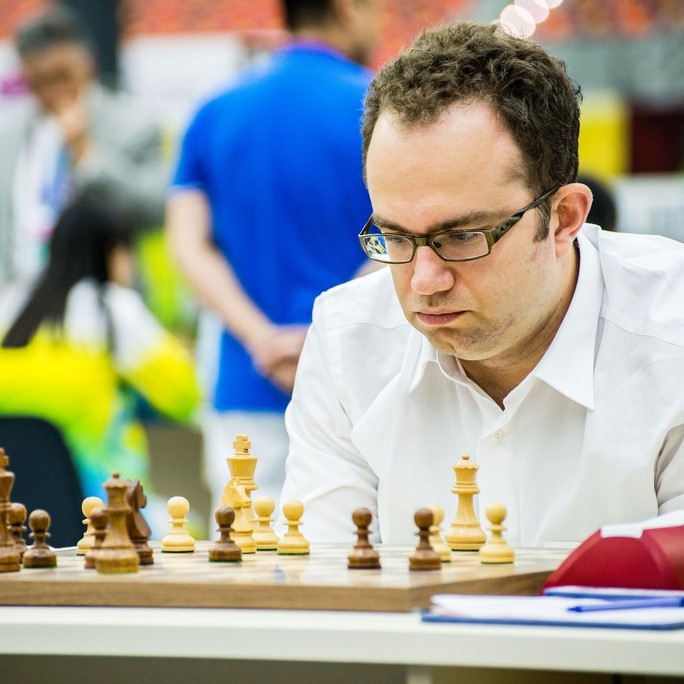
For nigh of u.s., remembering digits relies on short-term retention, or working retentiveness—the ability to concord information in our minds for a brief fourth dimension and work with it (due east.thou., multiplying 24 x 17 without using paper would rely on working memory). Another type of memory is episodic memory—the ability to call back the episodes of our lives. If you lot were given the task of recalling everything you did 2 days ago, that would be a exam of episodic memory; yous would be required to mentally travel through the mean solar day in your listen and notation the chief events. Semantic memory is our storehouse of more-or-less permanent knowledge, such equally the meanings of words in a linguistic communication (eastward.g., the significant of "parasol") and the huge collection of facts about the world (eastward.g., there are 196 countries in the world, and 206 bones in your torso). Collective memory refers to the kind of memory that people in a group share (whether family, customs, schoolmates, or citizens of a state or a land). For example, residents of small towns often strongly identify with those towns, remembering the local customs and historical events in a unique way. That is, the community'south collective retentivity passes stories and recollections between neighbors and to future generations, forming a memory arrangement unto itself.
Psychologists continue to contend the classification of types of memory, likewise as which types rely on others (Tulving, 2007), merely for this module we volition focus on episodic retention. Episodic memory is usually what people think of when they hear the word "memory." For example, when people say that an older relative is "losing her memory" due to Alzheimer's disease, the type of memory-loss they are referring to is the inability to recall events, or episodic retention. (Semantic memory is really preserved in early on-stage Alzheimer's disease.) Although remembering specific events that have happened over the course of one's entire life (e.thousand., your experiences in sixth class) can exist referred to as autobiographical memory, we volition focus primarily on the episodic memories of more recent events.
3 Stages of the Learning/Memory Process
Psychologists distinguish betwixt 3 necessary stages in the learning and memory process: encoding, storage, and retrieval (Melton, 1963). Encoding is divers every bit the initial learning of data; storage refers to maintaining information over time; retrieval is the ability to access information when you demand it. If you meet someone for the showtime time at a party, y'all need to encode her name (Lyn Goff) while you associate her name with her face up. And then you need to maintain the data over time. If yous see her a calendar week later, you lot need to recognize her face and have information technology serve as a cue to retrieve her proper name. Whatsoever successful act of remembering requires that all three stages be intact. Notwithstanding, ii types of errors can besides occur. Forgetting is one blazon: you see the person yous met at the party and you cannot recall her proper noun. The other error is misremembering (imitation recall or false recognition): you come across someone who looks like Lyn Goff and call the person by that proper noun (imitation recognition of the face). Or, y'all might run into the real Lyn Goff, recognize her face, simply then call her by the name of another woman you met at the party (misrecall of her name).
Whenever forgetting or misremembering occurs, we tin can ask, at which phase in the learning/retentivity process was in that location a failure?—though it is often difficult to respond this question with precision. One reason for this inaccuracy is that the three stages are non as discrete equally our description implies. Rather, all iii stages depend on 1 another. How nosotros encode information determines how it will exist stored and what cues volition exist constructive when we try to recollect information technology. And too, the human action of retrieval itself likewise changes the way information is subsequently remembered, usually aiding later recall of the retrieved information. The central indicate for now is that the three stages—encoding, storage, and retrieval—impact one another, and are inextricably spring together.
Encoding
Encoding refers to the initial experience of perceiving and learning information. Psychologists oft study recall by having participants report a list of pictures or words. Encoding in these situations is adequately straightforward. All the same, "real life" encoding is much more than challenging. When you walk across campus, for example, you see endless sights and sounds—friends passing past, people playing Frisbee, music in the air. The physical and mental environments are much too rich for y'all to encode all the happenings around you or the internal thoughts yous have in response to them. And so, an of import first principle of encoding is that information technology is selective: we nourish to some events in our surroundings and we ignore others. A second bespeak about encoding is that it is prolific; nosotros are e'er encoding the events of our lives—attending to the world, trying to empathise it. Normally this presents no trouble, as our days are filled with routine occurrences, and so nosotros don't need to pay attention to everything. But if something does happen that seems strange—during your daily walk across campus, you meet a giraffe—so we pay close attention and try to understand why we are seeing what nosotros are seeing.
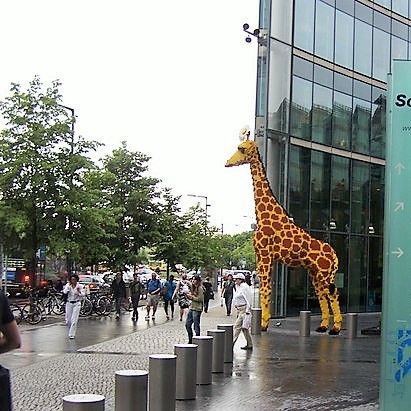
Right after your typical walk across campus (one without the appearance of a giraffe), you would be able to remember the events reasonably well if you were asked. You could say whom you bumped into, what vocal was playing from a radio, and and then on. Still, suppose someone asked you to recall the same walk a calendar month later on. You wouldn't stand a take a chance. You would likely be able to recount the nuts of a typical walk across campus, only not the precise details of that detail walk. Yet, if you had seen a giraffe during that walk, the event would accept been fixed in your heed for a long time, probably for the rest of your life. Yous would tell your friends about information technology, and, on later occasions when you saw a giraffe, you might be reminded of the 24-hour interval you saw ane on campus. Psychologists have long pinpointed distinctiveness—having an outcome stand up out as quite different from a background of similar events—as a cardinal to remembering events (Chase, 2003).
In addition, when vivid memories are tinged with strong emotional content, they often seem to leave a permanent mark on us. Public tragedies, such equally terrorist attacks, often create vivid memories in those who witnessed them. But fifty-fifty those of united states of america non directly involved in such events may have vivid memories of them, including memories of kickoff hearing nigh them. For case, many people are able to call back their exact physical location when they first learned about the assassination or accidental expiry of a national figure. The term flashbulb memory was originally coined past Brown and Kulik (1977) to describe this sort of vivid memory of finding out an important slice of news. The name refers to how some memories seem to be captured in the mind similar a flash photograph; because of the distinctiveness and emotionality of the news, they seem to get permanently etched in the mind with exceptional clarity compared to other memories.
Take a moment and think back on your own life. Is in that location a detail memory that seems sharper than others? A memory where you can recollect unusual details, like the colors of mundane things around you, or the exact positions of surrounding objects? Although people have great conviction in flashbulb memories like these, the truth is, our objective accuracy with them is far from perfect (Talarico & Rubin, 2003). That is, even though people may have great confidence in what they retrieve, their memories are not as accurate (eastward.g., what the actual colors were; where objects were truly placed) as they tend to imagine. Nonetheless, all other things being equal, distinctive and emotional events are well-remembered.
Details exercise non leap perfectly from the world into a person'southward mind. We might say that nosotros went to a party and remember it, merely what we remember is (at best) what we encoded. As noted above, the process of encoding is selective, and in complex situations, relatively few of many possible details are noticed and encoded. The process of encoding always involves recoding—that is, taking the data from the form it is delivered to us and then converting it in a way that we can brand sense of it. For example, you might try to remember the colors of a rainbow by using the acronym ROY G BIV (red, orange, yellowish, greenish, blueish, indigo, violet). The process of recoding the colors into a name can help us to remember. However, recoding can also introduce errors—when nosotros accidentally add together information during encoding, then remember that new fabric as if it had been function of the actual experience (as discussed beneath).
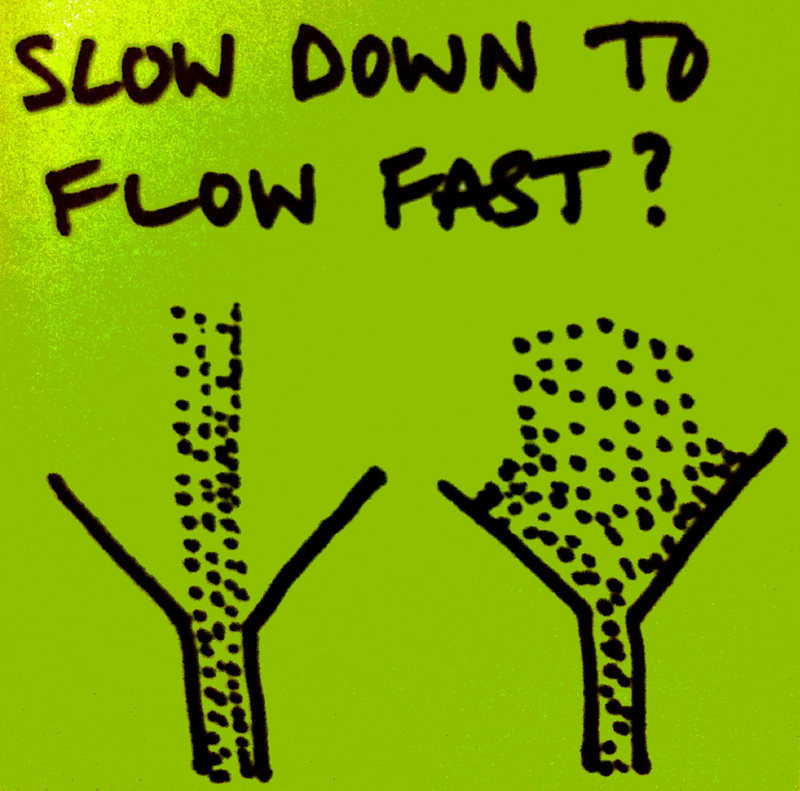
Psychologists have studied many recoding strategies that can exist used during study to improve retention. First, research advises that, every bit we study, we should think of the meaning of the events (Craik & Lockhart, 1972), and nosotros should endeavor to chronicle new events to information we already know. This helps us form associations that we tin use to call up information subsequently. 2nd, imagining events besides makes them more memorable; creating brilliant images out of information (even verbal information) tin greatly amend subsequently recall (Bower & Reitman, 1972). Creating imagery is role of the technique Simon Reinhard uses to remember huge numbers of digits, only we tin all use images to encode information more effectively. The basic concept behind good encoding strategies is to form distinctive memories (ones that stand up out), and to form links or associations among memories to help later on retrieval (Chase & McDaniel, 1993). Using written report strategies such every bit the ones described here is challenging, merely the effort is well worth the benefits of enhanced learning and retention.
Nosotros emphasized earlier that encoding is selective: people cannot encode all information they are exposed to. Yet, recoding can add information that was not even seen or heard during the initial encoding stage. Several of the recoding processes, like forming associations between memories, can happen without our awareness. This is one reason people tin sometimes remember events that did non actually happen—because during the process of recoding, details got added. One common manner of inducing false memories in the laboratory employs a give-and-take-list technique (Deese, 1959; Roediger & McDermott, 1995). Participants hear lists of 15 words, like door, glass, pane, shade, ledge, sill, business firm, open, curtain, frame, view, breeze, sash, screen, and shutter. Later, participants are given a test in which they are shown a list of words and asked to choice out the ones they'd heard earlier. This 2d listing contains some words from the first list (e.m., door, pane, frame) and some words not from the list (e.yard., arm, phone, canteen). In this instance, one of the words on the exam is window, which—importantly—does not appear in the outset listing, but which is related to other words in that list. When subjects were tested, they were reasonably authentic with the studied words (door, etc.), recognizing them 72% of the time. However, when window was on the examination, they falsely recognized it as having been on the list 84% of the time (Stadler, Roediger, & McDermott, 1999). The same thing happened with many other lists the authors used. This phenomenon is referred to as the DRM (for Deese-Roediger-McDermott) effect. One explanation for such results is that, while students listened to items in the list, the words triggered the students to think nigh window, even though window was never presented. In this manner, people seem to encode events that are not actually function of their experience.
Considering humans are creative, we are e'er going beyond the information we are given: we automatically brand associations and infer from them what is happening. But, as with the word association mix-up above, sometimes we brand simulated memories from our inferences—remembering the inferences themselves as if they were bodily experiences. To illustrate this, Brewer (1977) gave people sentences to remember that were designed to arm-twist businesslike inferences. Inferences, in general, refer to instances when something is not explicitly stated, but nosotros are still able to guess the undisclosed intention. For instance, if your friend told you that she didn't want to go out to eat, you may infer that she doesn't have the money to get out, or that she's too tired. With pragmatic inferences, in that location is usually one item inference you're probable to brand. Consider the statement Brewer (1977) gave her participants: "The karate champion hitting the cinder block." Afterwards hearing or seeing this judgement, participants who were given a memory test tended to call back the argument every bit having been, "The karate champion broke the cinder block." This remembered statement is not necessarily a logical inference (i.east., it is perfectly reasonable that a karate champion could hitting a cinder block without breaking it). Still, the businesslike conclusion from hearing such a judgement is that the block was likely broken. The participants remembered this inference they fabricated while hearing the sentence in place of the actual words that were in the sentence (meet also McDermott & Chan, 2006).
Encoding—the initial registration of information—is essential in the learning and memory procedure. Unless an upshot is encoded in some fashion, it will not be successfully remembered later. Even so, just because an issue is encoded (fifty-fifty if it is encoded well), there's no guarantee that information technology will be remembered later.
Storage
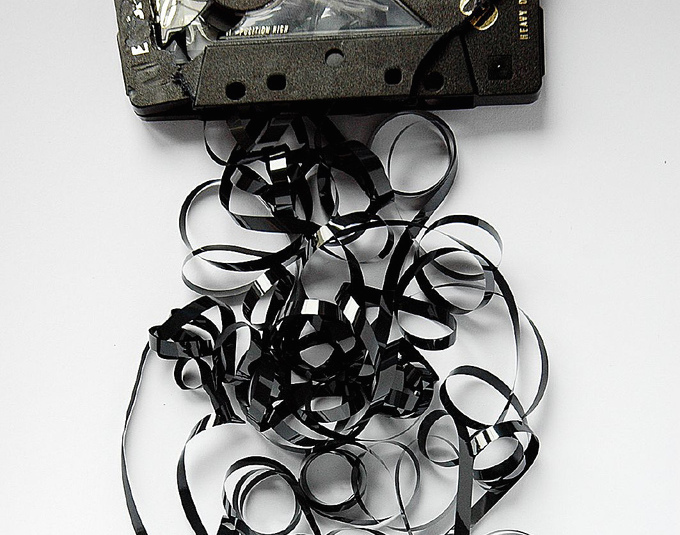
Every experience we take changes our brains. That may seem like a assuming, even strange, claim at beginning, but it's truthful. Nosotros encode each of our experiences within the structures of the nervous system, making new impressions in the process—and each of those impressions involves changes in the brain. Psychologists (and neurobiologists) say that experiences exit memory traces, or engrams (the two terms are synonyms). Memories have to be stored somewhere in the encephalon, and then in order to do so, the encephalon biochemically alters itself and its neural tissue. But like you might write yourself a note to remind you of something, the brain "writes" a retention trace, irresolute its own concrete composition to do and then. The bones idea is that events (occurrences in our environment) create engrams through a procedure of consolidation: the neural changes that occur after learning to create the memory trace of an experience. Although neurobiologists are concerned with exactly what neural processes change when memories are created, for psychologists, the term memory trace just refers to the concrete change in the nervous organization (whatever that may be, exactly) that represents our experience.
Although the concept of engram or memory trace is extremely useful, we shouldn't have the term besides literally. It is important to understand that memory traces are not perfect little packets of data that lie dormant in the encephalon, waiting to be called forward to give an authentic study of past experience. Retentiveness traces are not like video or sound recordings, capturing experience with groovy accuracy; as discussed earlier, nosotros often have errors in our memory, which would not exist if retentivity traces were perfect packets of information. Thus, it is wrong to think that remembering involves simply "reading out" a faithful record of by experience. Rather, when nosotros remember past events, we reconstruct them with the aid of our memory traces—just besides with our current belief of what happened. For instance, if you were trying to recall for the police force who started a fight at a bar, you lot may non have a retentiveness trace of who pushed whom kickoff. However, allow'southward say you remember that one of the guys held the door open for you. When thinking dorsum to the commencement of the fight, this knowledge (of how one guy was friendly to you) may unconsciously influence your memory of what happened in favor of the nice guy. Thus, memory is a construction of what y'all actually recall and what you believe happened. In a phrase, remembering is reconstructive (we reconstruct our past with the aid of retentiveness traces) not reproductive (a perfect reproduction or recreation of the past).
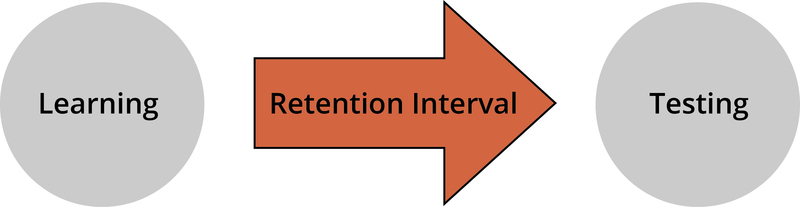
Psychologists refer to the time between learning and testing as the retention interval. Memories tin consolidate during that time, aiding retentiveness. However, experiences can also occur that undermine the memory. For example, call up of what you had for lunch yesterday—a pretty like shooting fish in a barrel task. Withal, if you had to recall what you had for lunch 17 days ago, you may well fail (bold yous don't consume the same thing every 24-hour interval). The 16 lunches you've had since that i have created retroactive interference. Retroactive interference refers to new activities (i.eastward., the subsequent lunches) during the retentiveness interval (i.e., the fourth dimension betwixt the lunch 17 days agone and now) that interfere with retrieving the specific, older memory (i.east., the lunch details from 17 days ago). But just as newer things can interfere with remembering older things, so can the opposite happen. Proactive interference is when past memories interfere with the encoding of new ones. For example, if you lot accept ever studied a second linguistic communication, often times the grammar and vocabulary of your native language will pop into your head, impairing your fluency in the foreign language.
Retroactive interference is one of the main causes of forgetting (McGeoch, 1932). In the module Eyewitness Testimony and Memory Biases http://noba.to/uy49tm37 Elizabeth Loftus describes her fascinating work on eyewitness memory, in which she shows how memory for an outcome can exist changed via misinformation supplied during the retention interval. For example, if you witnessed a automobile crash simply subsequently heard people describing it from their own perspective, this new information may interfere with or disrupt your own personal recollection of the crash. In fact, y'all may fifty-fifty come to remember the effect happening exactly as the others described it! This misinformation effect in eyewitness memory represents a blazon of retroactive interference that can occur during the retention interval (see Loftus [2005] for a review). Of grade, if right information is given during the retention interval, the witness'south memory will usually exist improved.
Although interference may arise between the occurrence of an event and the endeavor to recall it, the effect itself is always expressed when we remember memories, the topic to which we turn side by side.
Retrieval
Endel Tulving argued that "the cardinal process in memory is retrieval" (1991, p. 91). Why should retrieval be given more prominence than encoding or storage? For one matter, if information were encoded and stored merely could not be retrieved, it would exist useless. As discussed previously in this module, we encode and store thousands of events—conversations, sights and sounds—every mean solar day, creating memory traces. However, we later admission just a tiny portion of what nosotros've taken in. Most of our memories will never be used—in the sense of being brought back to listen, consciously. This fact seems and then obvious that we rarely reflect on it. All those events that happened to you in the fourth grade that seemed so important so? At present, many years later, you would struggle to remember even a few. You may wonder if the traces of those memories nevertheless exist in some latent form. Unfortunately, with currently available methods, it is impossible to know.
Psychologists distinguish data that is available in memory from that which is accessible (Tulving & Pearlstone, 1966). Available information is the data that is stored in memory—but precisely how much and what types are stored cannot be known. That is, all we can know is what information we can call up—accessible information. The assumption is that attainable information represents but a tiny slice of the data bachelor in our brains. Nearly of u.s. have had the feel of trying to remember some fact or consequence, giving up, and so—all of a sudden!—it comes to us at a later fourth dimension, even afterward we've stopped trying to remember it. Similarly, nosotros all know the feel of declining to retrieve a fact, simply then, if we are given several choices (as in a multiple-choice exam), we are easily able to recognize it.

What factors make up one's mind what information tin can be retrieved from retentivity? One critical factor is the type of hints, or cues, in the environs. You may hear a song on the radio that suddenly evokes memories of an earlier time in your life, even if y'all were non trying to remember it when the vocal came on. Nevertheless, the song is closely associated with that time, so it brings the experience to heed.
The general principle that underlies the effectiveness of retrieval cues is the encoding specificity principle (Tulving & Thomson, 1973): when people encode information, they do so in specific ways. For example, take the song on the radio: perhaps you lot heard it while you were at a terrific party, having a great, philosophical conversation with a friend. Thus, the song became role of that whole complex feel. Years later, fifty-fifty though y'all haven't thought nearly that party in ages, when you hear the song on the radio, the whole experience rushes back to you. In full general, the encoding specificity principle states that, to the extent a retrieval cue (the song) matches or overlaps the memory trace of an experience (the party, the conversation), information technology will be effective in evoking the memory. A classic experiment on the encoding specificity principle had participants memorize a set of words in a unique setting. Later on, the participants were tested on the word sets, either in the same location they learned the words or a different i. Equally a effect of encoding specificity, the students who took the test in the same identify they learned the words were actually able to call back more words (Godden & Baddeley, 1975) than the students who took the test in a new setting.
One caution with this principle, though, is that, for the cue to work, it tin't match too many other experiences (Nairne, 2002; Watkins, 1975). Consider a lab experiment. Suppose you study 100 items; 99 are words, and one is a moving-picture show—of a penguin, detail 50 in the list. Afterwards, the cue "recall the film" would evoke "penguin" perfectly. No one would miss it. However, if the word "penguin" were placed in the aforementioned spot among the other 99 words, its memorability would be exceptionally worse. This consequence shows the power of distinctiveness that nosotros discussed in the section on encoding: one picture is perfectly recalled from amongst 99 words because information technology stands out. Now consider what would happen if the experiment were repeated, but in that location were 25 pictures distributed within the 100-item list. Although the picture of the penguin would nonetheless be there, the probability that the cue "recall the picture" (at item fifty) would be useful for the penguin would drop correspondingly. Watkins (1975) referred to this outcome equally demonstrating the cue overload principle. That is, to be effective, a retrieval cue cannot be overloaded with too many memories. For the cue "recall the picture" to be effective, it should only lucifer 1 item in the target set (equally in the one-picture, 99-give-and-take case).
To sum upward how retentivity cues function: for a retrieval cue to exist effective, a lucifer must exist betwixt the cue and the desired target memory; furthermore, to produce the best retrieval, the cue-target relationship should be distinctive. Adjacent, we will see how the encoding specificity principle can work in practice.
Psychologists mensurate memory performance by using production tests (involving call up) or recognition tests (involving the selection of correct from wrong data, e.1000., a multiple-option examination). For case, with our list of 100 words, ane grouping of people might be asked to recall the list in any order (a free call back test), while a different grouping might be asked to circle the 100 studied words out of a mix with another 100, unstudied words (a recognition test). In this situation, the recognition exam would likely produce better performance from participants than the recall examination.
Nosotros usually recall of recognition tests as being quite easy, because the cue for retrieval is a copy of the actual consequence that was presented for report. After all, what could be a improve cue than the verbal target (memory) the person is trying to access? In virtually cases, this line of reasoning is truthful; nevertheless, recognition tests do not provide perfect indexes of what is stored in memory. That is, y'all tin can fail to recognize a target staring yous right in the face, yet be able to recall it later with a different set of cues (Watkins & Tulving, 1975). For example, suppose you had the task of recognizing the surnames of famous authors. At first, you might think that beingness given the actual last name would e'er exist the best cue. However, research has shown this not necessarily to be true (Muter, 1984). When given names such as Tolstoy, Shaw, Shakespeare, and Lee, subjects might well say that Tolstoy and Shakespeare are famous authors, whereas Shaw and Lee are non. But, when given a cued retrieve exam using starting time names, people often recall items (produce them) that they had failed to recognize before. For instance, in this instance, a cue similar George Bernard ________ often leads to a remember of "Shaw," even though people initially failed to recognize Shaw as a famous author'southward name. Yet, when given the cue "William," people may not come up up with Shakespeare, considering William is a mutual proper noun that matches many people (the cue overload principle at work). This foreign fact—that call back can sometimes lead to better performance than recognition—can be explained by the encoding specificity principle. As a cue, George Bernard _________ matches the way the famous writer is stored in retention better than does his surname, Shaw, does (fifty-fifty though information technology is the target). Further, the match is quite distinctive with George Bernard ___________, but the cue William _________________ is much more overloaded (Prince William, William Yeats, William Faulkner, will.i.am).
The phenomenon we have been describing is called the recognition failure of recallable words, which highlights the point that a cue will exist most effective depending on how the information has been encoded (Tulving & Thomson, 1973). The betoken is, the cues that work all-time to evoke retrieval are those that recreate the consequence or name to be remembered, whereas sometimes even the target itself, such every bit Shaw in the above example, is not the best cue. Which cue will exist well-nigh effective depends on how the information has been encoded.
Whenever nosotros think about our past, nosotros engage in the act of retrieval. We usually recollect that retrieval is an objective act because we tend to imagine that retrieving a memory is similar pulling a book from a shelf, and subsequently we are done with it, we return the book to the shelf just equally it was. Withal, inquiry shows this supposition to be false; far from beingness a static repository of data, the memory is constantly changing. In fact, every time we retrieve a memory, it is altered. For instance, the human activity of retrieval itself (of a fact, concept, or effect) makes the retrieved retentiveness much more likely to be retrieved again, a phenomenon called the testing effect or the retrieval practice effect (Pyc & Rawson, 2009; Roediger & Karpicke, 2006). However, retrieving some data can actually cause us to forget other information related to it, a phenomenon called retrieval-induced forgetting (Anderson, Bjork, & Bjork, 1994). Thus the act of retrieval tin can be a double-edged sword—strengthening the memory just retrieved (ordinarily by a large amount) only harming related information (though this event is often relatively small).
Equally discussed earlier, retrieval of distant memories is reconstructive. We weave the physical bits and pieces of events in with assumptions and preferences to form a coherent story (Bartlett, 1932). For example, if during your 10th birthday, your domestic dog got to your cake earlier you did, yous would likely tell that story for years afterward. Say, then, in later years you misremember where the dog actually plant the block, just repeat that mistake over and over during subsequent retellings of the story. Over fourth dimension, that inaccuracy would get a basic fact of the event in your mind. Only equally retrieval exercise (repetition) enhances authentic memories, so will information technology strengthen errors or false memories (McDermott, 2006). Sometimes memories can even be manufactured simply from hearing a brilliant story. Consider the following episode, recounted by Jean Piaget, the famous developmental psychologist, from his babyhood:
1 of my showtime memories would date, if it were truthful, from my second year. I tin can still run into, nigh clearly, the following scene, in which I believed until I was about 15. I was sitting in my pram . . . when a man tried to kidnap me. I was held in by the strap attached round me while my nurse bravely tried to stand between me and the thief. She received various scratches, and I can still vaguely see those on her face. . . . When I was about 15, my parents received a alphabetic character from my former nurse maxim that she had been converted to the Salvation Regular army. She wanted to confess her past faults, and in item to return the watch she had been given equally a advantage on this occasion. She had fabricated upward the whole story, faking the scratches. I therefore must have heard, as a child, this story, which my parents believed, and projected it into the by in the form of a visual retentivity. . . . Many existent memories are doubtless of the same lodge. (Norman & Schacter, 1997, pp. 187–188)
Piaget'southward bright business relationship represents a instance of a pure reconstructive retention. He heard the tale told repeatedly, and doubtless told it (and thought about it) himself. The repeated telling cemented the events as though they had really happened, just equally we are all open to the possibility of having "many real memories ... of the same order." The fact that one can remember precise details (the location, the scratches) does non necessarily indicate that the memory is true, a betoken that has been confirmed in laboratory studies, too (e.g., Norman & Schacter, 1997).
Putting It All Together: Improving Your Retentivity
A fundamental theme of this module has been the importance of the encoding and retrieval processes, and their interaction. To recap: to improve learning and memory, we need to encode information in conjunction with first-class cues that will bring back the remembered events when we need them. Only how practise we do this? Keep in mind the two critical principles we have discussed: to maximize retrieval, we should construct meaningful cues that remind us of the original experience, and those cues should be distinctive and not associated with other memories. These two conditions are critical in maximizing cue effectiveness (Nairne, 2002).
So, how can these principles be adapted for apply in many situations? Let'south get back to how we started the module, with Simon Reinhard'south ability to memorize huge numbers of digits. Although information technology was non obvious, he applied these same general retentivity principles, but in a more than deliberate way. In fact, all mnemonic devices, or retention aids/tricks, rely on these central principles. In a typical case, the person learns a ready of cues and then applies these cues to larn and retrieve information. Consider the set of 20 items below that are like shooting fish in a barrel to learn and remember (Bower & Reitman, 1972).
- is a gun. 11 is penny-one, hot dog bun.
- is a shoe. 12 is penny-two, airplane glue.
- is a tree. 13 is penny-three, bumble bee.
- is a door. xiv is penny-iv, grocery store.
- is knives. 15 is penny-five, big beehive.
- is sticks. 16 is penny-six, magic tricks.
- is oven. 17 is penny-seven, become to heaven.
- is plate. 18 is penny-eight, golden gate.
- is wine. xix is penny-9, brawl of twine.
- is hen. 20 is penny-ten, ballpoint pen.
It would probably take you less than ten minutes to acquire this list and practise recalling information technology several times (remember to utilise retrieval do!). If you were to do so, you lot would take a set of peg words on which you could "hang" memories. In fact, this mnemonic device is called the peg word technique. If you and so needed to remember some discrete items—say a grocery listing, or points you wanted to make in a speech—this method would let you do and so in a very precise yet flexible manner. Suppose yous had to remember bread, peanut butter, bananas, lettuce, then on. The way to use the method is to form a vivid prototype of what yous want to remember and imagine information technology interacting with your peg words (as many as you need). For instance, for these items, you might imagine a large gun (the offset peg word) shooting a loaf of bread, then a jar of peanut butter inside a shoe, then large bunches of bananas hanging from a tree, so a door slamming on a head of lettuce with leaves flying everywhere. The idea is to provide good, distinctive cues (the weirder the better!) for the information you demand to call up while you are learning it. If you do this, then retrieving it after is relatively like shooting fish in a barrel. You know your cues perfectly (one is gun, etc.), and then you simply go through your cue word list and "look" in your mind's eye at the paradigm stored there (staff of life, in this case).
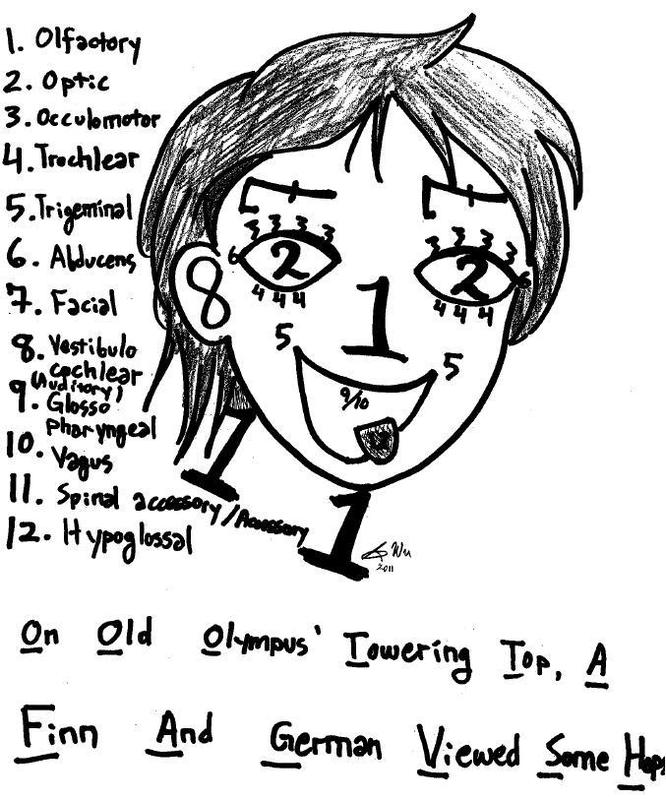
This peg word method may sound foreign at first, but it works quite well, even with petty preparation (Roediger, 1980). One word of warning, though, is that the items to be remembered need to exist presented relatively slowly at showtime, until you have practise associating each with its cue word. People get faster with time. Another interesting attribute of this technique is that information technology's just as easy to recall the items in backwards order as frontward. This is because the peg words provide direct access to the memorized items, regardless of guild.
How did Simon Reinhard remember those digits? Essentially he has a much more complex system based on these same principles. In his case, he uses "retentiveness palaces" (elaborate scenes with detached places) combined with huge sets of images for digits. For case, imagine mentally walking through the dwelling where you grew up and identifying as many distinct areas and objects every bit possible. Simon has hundreds of such memory palaces that he uses. Next, for remembering digits, he has memorized a fix of 10,000 images. Every four-digit number for him immediately brings along a mental image. So, for example, 6187 might recall Michael Jackson. When Simon hears all the numbers coming at him, he places an prototype for every iv digits into locations in his memory palace. He tin practise this at an incredibly rapid rate, faster than 4 digits per iv seconds when they are flashed visually, as in the sit-in at the beginning of the module. As noted, his record is 240 digits, recalled in exact gild. Simon also holds the world record in an result chosen "speed cards," which involves memorizing the precise club of a shuffled deck of cards. Simon was able to exercise this in 21.19 seconds! Over again, he uses his retentivity palaces, and he encodes groups of cards as single images.
Many books exist on how to ameliorate memory using mnemonic devices, but all involve forming distinctive encoding operations and and then having an infallible set of memory cues. We should add that to develop and use these memory systems beyond the basic peg arrangement outlined above takes a great corporeality of time and concentration. The Earth Memory Championships are held every year and the records keep improving. However, for most common purposes, just keep in mind that to remember well you need to encode information in a distinctive way and to have good cues for retrieval. You can adapt a organisation that volition meet virtually any purpose.
Exterior Resources
- Volume: Brown, P.C., Roediger, H. 50. & McDaniel, One thousand. A. (2014). Make it stick: The science of successful learning. Cambridge, MA: Harvard University Press.
- https://world wide web.amazon.com/Make-Stick-Science-Successful-Learning/dp/0674729013
- Student Video 1: Eureka Foong\\\\\\\'s - The Misinformation Effect. This is a educatee-fabricated video illustrating this phenomenon of altered retention. Information technology was one of the winning entries in the 2014 Noba Educatee Video Laurels.
-
- Student Video 2: Kara McCord\\\\\\\'s - Flashbulb Memories. This is a student-made video illustrating this miracle of autobiographical memory. It was i of the winning entries in the 2014 Noba Student Video Honor.
-
- Educatee Video 3: Ang Rui Xia & Ong Jun Hao\\\\\\\'southward - The Misinformation Effect. Some other student-made video exploring the misinformation effect. Too an accolade winner from 2014.
-
- Video: Simon Reinhard breaking the globe record in speedcards.
-
- Web: Retrieval Practice, a website with research, resources, and tips for both educators and learners around the memory-strengthening skill of retrieval practise.
- http://www.retrievalpractice.org/
Discussion Questions
- Mnemonists like Simon Reinhard develop mental "journeys," which enable them to use the method of loci. Develop your own journey, which contains 20 places, in society, that you know well. One example might be: the front walkway to your parents' flat; their doorbell; the couch in their living room; etc. Be sure to use a prepare of places that you know well and that have a natural guild to them (eastward.g., the walkway comes before the doorbell). Now you lot are more than halfway toward being able to memorize a fix of xx nouns, in social club, rather quickly. As an optional second step, have a friend make a list of 20 such nouns and read them to y'all, slowly (due east.g., ane every 5 seconds). Use the method to effort to remember the 20 items.
- Recall a contempo argument or misunderstanding you accept had virtually retention (e.g., a debate over whether your girlfriend/swain had agreed to something). In lite of what you take just learned nearly memory, how exercise you lot recollect about it? Is it possible that the disagreement tin be understood by one of y'all making a pragmatic inference?
- Think virtually what you've learned in this module and well-nigh how you study for tests. On the basis of what y'all have learned, is there something yous want to try that might aid your study habits?
Vocabulary
- Autobiographical memory
- Memory for the events of one's life.
- Consolidation
- The process occurring afterward encoding that is believed to stabilize memory traces.
- Cue overload principle
- The principle stating that the more memories that are associated to a particular retrieval cue, the less effective the cue will be in prompting retrieval of any one memory.
- Distinctiveness
- The principle that unusual events (in a context of similar events) will be recalled and recognized meliorate than uniform (nondistinctive) events.
- Encoding
- The initial experience of perceiving and learning events.
- Encoding specificity principle
- The hypothesis that a retrieval cue will be effective to the extent that information encoded from the cue overlaps or matches information in the engram or retention trace.
- Engrams
- A term indicating the change in the nervous system representing an event; too, memory trace.
- Episodic memory
- Memory for events in a particular time and place.
- Flashbulb memory
- Vivid personal memories of receiving the news of some momentous (and usually emotional) issue.
- Memory traces
- A term indicating the modify in the nervous system representing an effect.
- Misinformation outcome
- When erroneous information occurring after an event is remembered as having been part of the original event.
- Mnemonic devices
- A strategy for remembering big amounts of data, commonly involving imaging events occurring on a journeying or with some other prepare of memorized cues.
- Recoding
- The ubiquitous process during learning of taking information in one grade and converting information technology to some other form, usually 1 more easily remembered.
- Retrieval
- The process of accessing stored information.
- Retroactive interference
- The phenomenon whereby events that occur after some particular issue of involvement will usually cause forgetting of the original effect.
- Semantic memory
- The more or less permanent shop of cognition that people take.
- Storage
- The stage in the learning/memory process that bridges encoding and retrieval; the persistence of memory over time.
References
- Anderson, M. C., Bjork, R., & Bjork, Due east. L. (1994). Remembering can cause forgetting: Retrieval dynamics in long-term retentiveness. Journal of Experimental Psychology-Learning Retention and Cognition, xx, 1063–1087.
- Bartlett, F. C. (1932). Remembering: A study in experimental and social psychology. Cambridge: Cambridge Academy Press.
- Bower, Yard. H., & Reitman, J. South. (1972). Mnemonic elaboration in multilist learning. Journal of Verbal Learning and Verbal Behavior, 11, 478–485.
- Brewer, W. F. (1977). Memory for the pragmatic implications of sentences. Memory & Cognition, five(6), 673–678.
- Brown, R., & Kulik, J. (1977). Flashbulb memories. Knowledge, 5, 73–99.
- Chan, J.C.K. & McDermott, 1000.B. (2006). Remembering pragmatic inferences. Applied Cognitive Psychology, 20, 633-639.
- Craik, F. I. K., & Lockhart, R. Due south. (1972). Levels of processing: A framework for retentiveness inquiry. Journal of Exact Learning and Exact Beliefs, 11, 671–684.
- Deese, J. (1959). On the prediction of occurrence of particular verbal intrusions in firsthand recall. Journal of Experimental Psychology, 58, 17.
- Godden, D. R., & Baddeley, A. D. (1975). Context‐dependent retention in two natural environments: On country and underwater. British Periodical of Psychology,66 (three), 325-331
- Hunt, R. (2003). Two contributions of distinctive processing to accurate memory. Journal of Memory and Language, 48, 811–825.
- Hunt, R., & McDaniel, Grand. A. (1993). The enigma of organization and distinctiveness. Journal of Retention and Linguistic communication, 32, 421-445.
- Loftus, E. F. (2005). Planting misinformation in the human mind: A 30-twelvemonth investigation of the malleability of memory. Learning & Memory, 12, 361–366.
- McDermott, Thousand. B. (2006). Paradoxical effects of testing: Repeated retrieval attempts enhance the likelihood of later accurate and imitation recall. Retention & Knowledge, 34, 261–267.
- McGeoch, J. A. (1932). Forgetting and the constabulary of disuse. Psychological Review, 39(four), 352.
- Melton, A. W. (1963). Implications of short-term retentivity for a general theory of retention. Journal of Verbal Learning and Exact Beliefs, 2, 1–21.
- Miller, G. A. (1956). The magical number seven, plus or minus two: Some limits on our capacity for processing information. Psychological Review, 63, 81–97.
- Muter, P. (1984). Recognition and recall of words with a single meaning. Journal of Experimental Psychology: Learning, Memory, and Cognition, ten, 198–202.
- Nairne, J. S. (2002). The myth of the encoding-retrieval match. Memory, 10, 389–395.
- Norman, K. A., & Schacter, D. L. (1997). Imitation recognition in younger and older adults: Exploring the characteristics of illusory memories. Retention & Noesis, 25, 838–848.
- Pyc, M. A., & Rawson, G. A. (2009). Testing the retrieval effort hypothesis: Does greater difficulty correctly recalling information atomic number 82 to higher levels of memory? Journal of Memory and Linguistic communication, threescore, 437–447.
- Roediger, H. L. (1980). The effectiveness of four mnemonics in ordering think. Journal of Experimental Psychology: Human being Learning and Memory, half dozen, 558.
- Roediger, H. 50., & Karpicke, J. D. (2006). Test-enhanced learning: Taking memory tests improves long-term retention. Psychological Scientific discipline, 17, 249–255.
- Roediger, H. 50., & McDermott, K. B. (1995). Creating false memories: Remembering words not presented in lists. Journal of Experimental Psychology-Learning Memory and Cognition, 21, 803–814.
- Stadler, M. A., Roediger, H. Fifty., & McDermott, Thousand. B. (1999). Norms for give-and-take lists that create simulated memories. Memory & Cognition, 27, 494–500.
- Talarico, J. Thousand., & Rubin, D. C. (2003). Confidence, not consistency, characterizes flashbulb memories. Psychological Science, 14, 455–461.
- Tulving, Eastward. (2007). Are in that location 256 unlike kinds of memory? In J.South. Nairne (Ed.), The foundations of remembering: Essays in award of Henry Fifty. Roediger, Iii (pp. 39–52). New York: Psychology Press.
- Tulving, E. (1991). Interview. Journal of Cognitive Neuroscience, 3, 89–94
- Tulving, Eastward., & Bower, G. H. (1975). The logic of memory representations. The psychology of learning and motivation, 8, 265-301.
- Tulving, E., & Pearlstone, Z. (1966). Availability versus accessibility of information in memory for words. Journal of Verbal Learning and Verbal Behavior, five, 381–391.
- Tulving, E., & Thomson, D. M. (1973). Encoding specificity and retrieval processes in episodic retentiveness. Psychological Review, 80, 352–373.
- Tulving, E., & Thomson, D. Chiliad. (1973). Encoding specificity and retrieval processes in episodic retention. Psychological Review, 80, 352–373.
- Watkins, G. J. (1975). Inhibition in call up with extralist "cues." Periodical of Exact Learning and Exact Behavior, xiv, 294–303.
- Watkins, M. J., & Tulving, East. (1975). Episodic memory: When recognition fails. Periodical of Experimental Psychology: General, 104, 5–29.
Authors
Artistic Commons License


 Memory (Encoding, Storage, Retrieval) by Kathleen B. McDermott and Henry L. Roediger III is licensed nether a Artistic Eatables Attribution-NonCommercial-ShareAlike 4.0 International License. Permissions beyond the scope of this license may exist available in our Licensing Agreement.
 How to cite this Noba module using APA Manner
McDermott, K. B. & Roediger, H. L. (2022). Memory (encoding, storage, retrieval). In R. Biswas-Diener & East. Diener (Eds), Noba textbook serial: Psychology. Champaign, IL: DEF publishers. Retrieved from http://noba.to/bdc4ugerSource: https://nobaproject.com/modules/memory-encoding-storage-retrieval
0 Response to "When Information Is Repeated Over and Over Again Until It Is No Longer Needed the Process of"
Enregistrer un commentaire